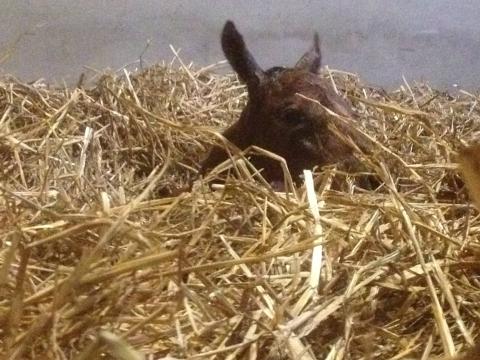
We welcome your mares to assist them during their delivery, to ensure that the process goes smoothly and without complications. We place importance on monitoring the progress of labour, preparing for assistance if needed, and documenting any events or abnormalities. The main goal is to maximize the chances of a healthy birth of a viable foal.
Unfortunately, foaling carries risks for both the mare and the foal. Some of the most common risks include
- Labour problems: Labour can be difficult or insufficient, which can lead to problems for both mare and foal.
- Uterine prolapse: Uterine prolapse is a condition in which the uterus turns over and can exit through the vagina, which can be an emergency situation.
- Placenta retention: Placenta retention is a condition in which the placenta does not detach properly from the uterus, which can lead to infections and other health problems for the mare.
- Premature birth: The foal may be born prematurely, or show symptoms of mal-adaptation.
- Delivery injuries: The foal may be injured at birth, and show rib fractures or bladder tearing for example. The mare may suffer from haemorrhages, pelvic or pelvic canal injuries and other pathologies.
It is important to monitor the mare carefully during foaling and be prepared to intervene if necessary to minimise the risk to the mare and foal.
Warning signs of foaling in mares include
- Change in appetite: The mare may lose or reduce her appetite or become more nervous.
- Hormonal changes: The mare may have a drop in oestrogen levels and an increase in prostaglandin production, which may trigger labour.
- Change in body temperature: The mare's body temperature may drop before labour begins and rise after delivery.
- Change in behaviour: The mare may become more nervous, walk in circles, lie down and get up frequently.
- Change in vulva: The mare's vulva may become more red and swollen, and may start to secrete a clear fluid.
- Change in udder: Milk may flow in the hours or days before foaling, or sometimes wax "candles" may appear.
However, these signs can vary between mares and it is important to monitor the mare carefully for early signs of foaling and act accordingly. We use sensors to help us determine the time of foaling, to improve the possibility of early intervention if necessary, which can improve the chances of a viable foal being born.
Add new comment